
NIST Traceability in Scale Calibration
Every Cech calibration certificate includes an unbroken NIST traceability chain. Here's what that means in practice.
What NIST Traceability Actually Is
NIST traceability is not a certification or a label — it is a property of a measurement result that establishes its relationship to nationally recognized measurement standards through a documented, unbroken chain of calibrations. The National Institute of Standards and Technology maintains primary reference standards for all fundamental measurement quantities, including mass.
When a calibration certificate claims NIST traceability, it asserts that the reference weights used in that calibration were themselves calibrated by a laboratory whose reference weights were calibrated by a laboratory whose reference weights ultimately connect — through a defined number of calibration steps — to NIST's own mass standards.
The Traceability Chain
The traceability chain for a field scale calibration typically runs: NIST primary standards → accredited reference laboratory (such as a state weights and measures laboratory or an accredited commercial calibration lab) → field calibration service provider's working reference weights → the scale being calibrated. Each link in the chain must be documented with a current calibration certificate for the reference standards used at that step. An expired certificate at any link in the chain breaks the traceability — the claim of NIST traceability is only as valid as the most recently expired certificate in the chain.
What Cech Provides in the Traceability Documentation
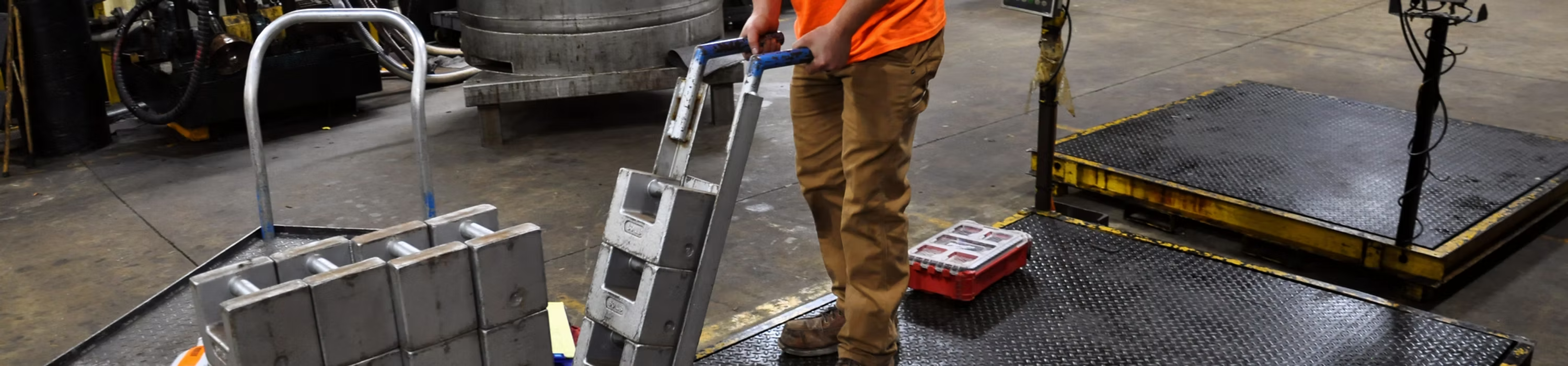
Every Cech calibration certificate identifies the reference weights used in the calibration — by certificate number, issuing laboratory, nominal value, certified value, calibration date,and certificate expiration date. This information allows the receiving quality system to verify the traceability chain independently, confirm that all reference certificates were current at the time of calibration, and establish the reference standard uncertainty contribution to the overall calibration uncertainty. For operations whose quality management systems require this documentation to be on file, Cech provides it as a standard element of the calibration record — not a supplementary request.
Q: Does NIST traceability guarantee my scale is accurate?
NIST traceability establishesthat the reference standard used in the calibration is accurate relative tonational standards. It does not by itself guarantee that your scale was accurately calibrated — that depends on the technician's competence, the calibration procedure used, and the environmental conditions at calibration. ISO 17025 accreditation addresses these additional elements. Traceability is a necessary condition for a valid calibration; it is not sufficient on its own.
Q: How do I know if my calibration certificate establishes traceability?
A certificate that establishes NIST traceability will identify the specific reference standards used (by certificate number and issuing lab), confirm those certificates were current at the time of calibration, and state the traceability claim explicitly. A certificate that says only 'calibrated to NIST standards' or 'NIST traceable' without identifying the reference standards used does not establish a verifiable traceability chain.
Request a sample certificate →
Our Quality Guarantee
At Cech Scale, three generations of German precision and decades of field experience guide every install, calibration, and repair. When our name goes on the work, it carries that lineage, sets the standard we live by, and stands as a promise to perform today and for years to come.